
RESUME | The role of auditors in safeguarding corporate assets and maintaining the stability of financial markets is often called into question whenever a financial scandal receives media attention. In recent years, these scandals have led several countries to strengthen their national legislation on audit regulation.
Since audit research is often driven by these regulatory changes, scholars have focused on the motivations that lead companies to choose one auditor over another. The literature review identifies two main motivations that determine auditor choice: an economic motivation and a sociological one.
Economic motivation explains the choice of auditors by companies facing agency problems and information asymmetry, or by those seeking insurance coverage in case of potential economic loss. Sociological motivation, on the other hand, is driven by the pursuit of legitimacy through auditing, enabling companies to respond to environmental pressures and requirements.
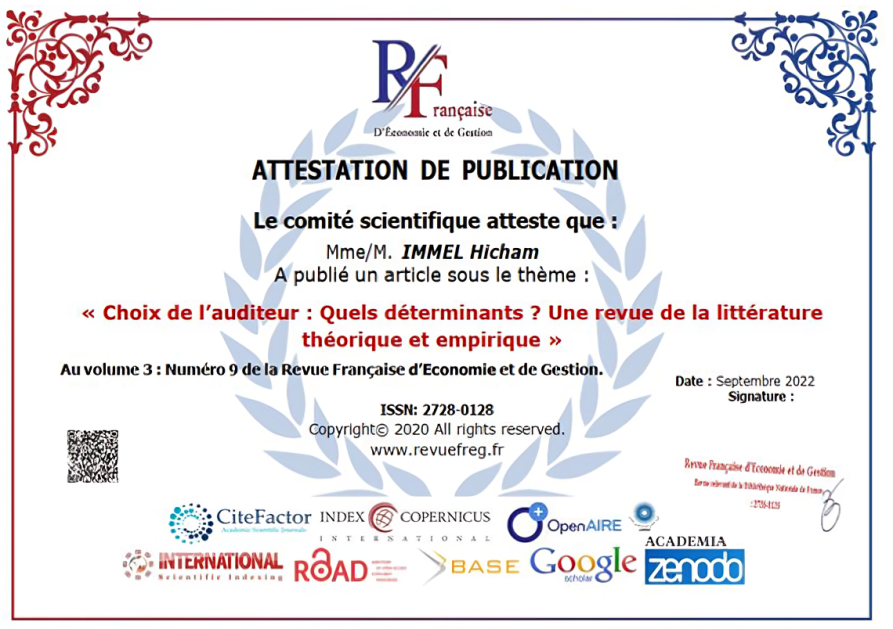
This article aims to present a theoretical research model on the determinants of auditor choice and to provide an empirical overview of the application of this model.
Keywords: Auditor choice; agency theory; information asymmetry; governance; audit quality